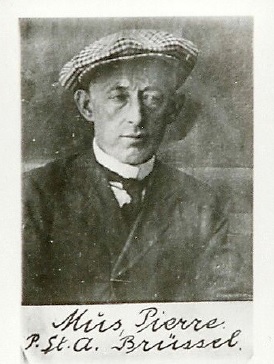
| The gendarme Gustave Mus is arrested 1915 recruited by the Belgian intelligence service to set up a spy network in occupied Belgium. The network composed of gendarmes must monitor the movements of German troops. Originally their network was called “the gendarmes network”. This name changes to “the outpatient network”. | The gendarme Gustave Mus is recruited in May 1915 by the Belgian Intelligence Service to set up a spy network in occupied Belgium. The network composed of numerous gendarmes was responsible in watching the movements of the German troops. Therefore it was initially named “The Gendarmes network”, an appellation wisely replaced later by “The Ambulants network”. | Gustave Mus, constable, was recruited in May 1915 by the Belgian intelligence service to found a spy network in occupied Belgium. The network, responsible for spying on the movements of German troops, initially relies on gendarmes, hence its name “Gendarmes network”, carefully then transformed into a “Walkers’ network”. |
| Two brothers of Gustave Mus – Pierre, a tailor, in François, a postal worker – are part of it. Gustave and François Mus are indicated and, with other agents, in the summer of 1916 executed. This has largely decapitated the network. | Two brothers of Gustave Mus – Pierre, of tails, and François, a postman – are part of it. Denounced alongside other numerous agents, Gustave and François Mus are condemned and shot by the Germans during the summer of 1916. The network is then largely dismantled. | Two brothers of Gustave – Pierre, tailor, and Francis, postman – are part of it. Gustave and François, denounced, were arrested with other agents by the Germans and shot during the summer 1916. The network is largely dismantled. |
| Agile and good at disguise, Pierre Mus manages to escape the German's traps. He was sentenced to death in absentia twice: for espionage, and for the murder of a German soldier. He effectively has the soldier who would take him to the Kommandantur, murdered because he had compromising documents in his pocket at the time of an identity check. | Nimble, expert in disguise, Pierre Mus never falls in the traps set up by the German secret police. He is twice sentenced to death in absentia: once for espionage, once for the murder of a German soldier. Indeed, endangered during an identity check and in possession of sensitive documents, he killed the soldier that was taking him to the Kommandantur. | Agile, fan of cross-dressing, Pierre Mus manages to escape all the traps set. He is sentenced to death twice in default: once for espionage, another for the murder of a German soldier. Indeed, endangered during an identity check and in possession of compromising documents, he kills the German soldier who takes him to the Kommandantur. |
| Pierre Mus manages to transfer numerous documents. He contributes to providing the plans for the port of Zeebrugge to the Allies. These plans are essential for the British attack in April 1918 with the aim of blocking the German submarines. After the war, many people fell upon him in turn. | Pierre Mus succeeded in transmitting numerous documents. He helped to provide the Allies the maps of the Zeebrugge harbour that played a capital role in the April 1918 British raid, an operation aimed at blocking the way out of the German U-boats. After the war, he was decorated with numerous . | Pierre Mus sent numerous documents during the war. He helps provide the allies with plans for the port of Zeebrugge, who played a vital role in the British raid of April 1918 intended to block the exit of German submarines. He receives many after the war. |

 PIERRE MUS : THE ADVENTUROUS JOURNEY OF AN INTELLIGENCE AGENT
 PIERRE MUS : THE EVENTUAL JOURNEY OF AN INTELLIGENCE AGENT