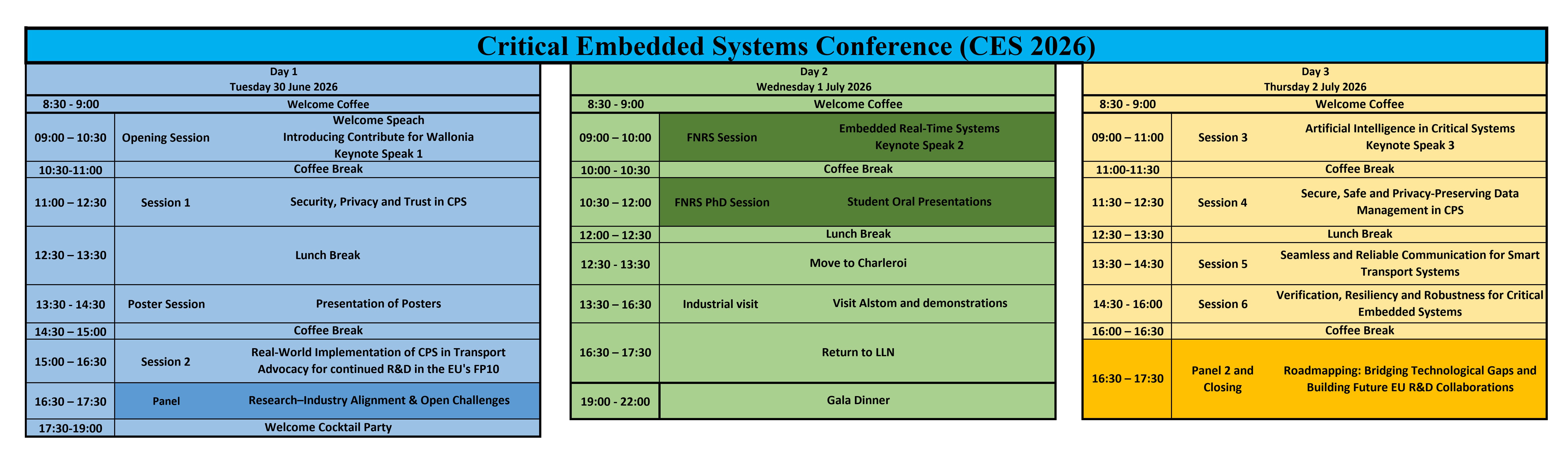
08:30 - 09:00 | Welcome Coffee
09:00 - 11:00 | Session on Artificial Intelligence in Critical Systems
-
Keynote Speak
From Dynamic Positioning to Autonomous Navigation: Real-Time
Control, Redundancy, and Fail-Safe Design Challenges
Marko Valčić — University of Zadar
Time: 09:00 - 10:00
Abstract
This keynote lecture traces the engineering path from
dynamic positioning (DP) to fully autonomous maritime navigation. Dynamic
positioning is presented as a mature, certified template: a hard real-time control
loop that holds a vessel on station using only active thrusters, structured around
estimation, control, and thrust allocation. The talk then examines Maritime
Autonomous Surface Ships (MASS), whose first international framework, the IMO MASS
Code, entered into effect on 1 July 2026. Building on this foundation, it considers
where artificial intelligence enters the loop, in perception, decision making, and
learned control, and why the assurance of such components remains an open problem. A
structured comparison of DP and MASS follows, addressing redundancy, the shift from
fail-safe to fail-operational behaviour, remote operation centres, communication
layering, operator competencies, cybersecurity, and the implications for ports. The
presentation closes with open questions on certification and education, arguing that
the embedded systems community is well-positioned to address the safety, real-time,
and verification challenges that autonomous shipping now poses.
-
Secure Federated Learning on Medical Data and Perspectives for its
Transposition to the Transport and Mobility Sector
Xavier Lessage — CETIC (Senior Research Engineer)
Time: 10:00 - 10:30
Abstract
Artificial Intelligence increasingly relies on large
volumes of distributed data that are often sensitive, regulated, and difficult to
centralize. In healthcare, Federated Learning (FL) has emerged as a promising
paradigm enabling multiple institutions to collaboratively train AI models while
keeping patient data locally under their control. However, real-world deployments
have revealed important challenges related to privacy, cybersecurity, trust, model
robustness, and regulatory compliance.
This presentation will provide an overview of recent advances in Secure Federated
Learning for medical imaging applications, including privacy-preserving techniques,
Fully Homomorphic Encryption (FHE), secure aggregation, trusted execution
environments, differential privacy, and federated model governance. Drawing from
practical experiences in collaborative healthcare AI projects, we will discuss the
benefits and limitations of current approaches and highlight key lessons learned
from deploying FL in highly regulated environments.
Building on these insights, the presentation will explore how Secure Federated
Learning can be transposed to the transport and mobility sector. As connected
vehicles, smart infrastructures, and mobility platforms generate massive distributed
datasets, similar challenges arise regarding data ownership, privacy protection,
cybersecurity, and cross-organizational collaboration. We will examine potential use
cases, architectural considerations, and emerging research opportunities where
privacy-preserving collaborative AI could accelerate innovation while maintaining
trust and regulatory compliance.
-
Automated and Tailor-Made Fault Detection for Valve Bellows Using
Profilometry, Machine Vision, and AI-Based Diagnosis
Jérôme Ligot - V2i (Head of Systems Division)
Time: 10:30 - 11:00
Abstract
This contribution presents an automated and tailor-made
fault detection system developed for the quality inspection of valve bellows in an
automotive production environment.
The system, already deployed in production, combines complementary sensing
technologies, including in-line profilometers, line-scan cameras, matrix cameras,
and dedicated lighting configurations, to detect both geometric and visual defects
at production speed. Profilometry data are processed using a classification model
for welding defect detection, while visual defects are identified through
image-based inspection modules relying on segmentation models. The complete solution
integrates data acquisition, signal and image post-processing, AI-based defect
diagnosis, PLC communication, and an operator-oriented HMI.
By replacing manual visual inspection with consistent, traceable, and real-time
automated decisions, the system improves quality control reliability and supports a
zero-defect manufacturing approach for critical valve bellow components used in
automotive applications.
11:00 - 11:30 | Coffee Break
11:30 - 12:30 | Session on Safe, Secure and Privacy-Preserving Data Management in CPS
Session Chair: Mohsen Shirali (UCLouvain)
-
Secure Physical AI at the Edge: Virtualization, Isolation, and
Trusted AI Execution for Cyber-Physical Systems
Alessandro Biondi — Scuola Superiore Sant'Anna (RETIS lab)
Time: 11:30 - 12:00
Abstract
The increasing adoption of Physical AI in cyber-physical systems is driving the
deployment of advanced AI capabilities directly on embedded edge platforms, where
real-time constraints, safety requirements, and cybersecurity concerns must coexist.
This talk discusses architectural and system-software technologies enabling the
secure execution of AI workloads on heterogeneous embedded platforms operating in
critical domains such as transportation, robotics, industrial automation, and
aerospace.
The presentation will introduce hypervisor-based virtualization and isolation
mechanisms that allow multiple applications with different safety and security
requirements to share the same hardware platform while maintaining strong separation
and predictable behavior. It will then discuss approaches to protect AI-enabled
systems against cyber attacks, including secure execution environments, runtime
monitoring, and mechanisms to safeguard intellectual property by preventing AI model
theft and unauthorized access to sensitive data.
Finally, the talk will explore the concept of multi-enclave AI execution, where
multiple AI models with different criticality, safety, and security levels can
coexist on the same chip within isolated trusted domains. This approach enables the
consolidation of heterogeneous workloads while preserving security, resilience, and
certification requirements, paving the way toward trustworthy Physical AI at the
edge.
-
MOZAIK: An MPC-Based Approach to Privacy-Preserving Data Management
in Cyber-Physical Systems
Aysajan Abidin — COSIC, KU Leuven
Time: 12:00 - 12:30
12:30 - 13:30 | Lunch Break
13:30 - 14:30 | Session on Seamless and Reliable Communication for Smart Transport Systems
Session Chair: Cristel Pelsser (UCLouvain)
-
Smart Connectivity in Inland Waterways: From Analysis to Deployment
Ahmed Bannour — Multitel (BE) and FPM-UMONS (BE)
Time: 13:30 - 14:00
Abstract
This presentation will focus on the results, observations,
and quality assessment approaches derived from two of Multitel's projects in the
smart transport domain:
Navauwal:
concerning the remote control of inland waterway barges
Lusta-5G:
works on the remote control of cranes in an inland
waterway port
-
Efficient Route Planning for EVs
Jean-Sébastien Gonsette — AISIN Europe (Expert IA & Computer Sciences
Engineer)
Time: 14:00 - 14:30
14:30 - 16:00 | Session on Verification, Resiliency and Robustness for Critical Embedded
Systems
Session Chair: Jean-Christophe Deprez (Director of Research and Innovation, CETIC)
-
Critical Network Service Management in the Age of Agentic AI: From
Automation to Resilience
Charalampos Rotsos — Lancaster University, DIA
Time: 14:00 - 14:30
Abstract
Network infrastructures have undergone a significant
transformation in recent years, evolving from human-centric and manually operated
environments to autonomous software-defined multi-domain management systems. This
evolution towards autonomous networking has further accelerated with the advent of
agentic AI, which has the potential to improve the efficiency and responsiveness of
network service deployment, monitoring, and management. Nonetheless, the adoption of
agentic AI in network management also raises important concerns related to security,
reliability, and resilience. In this talk, we will explore current architectural
trends in autonomous network management with agentic AI and discuss the
opportunities and challenges associated with delivering network services for
critical embedded systems, with a particular focus on resilience. Finally, we will
discuss architectural principles and mechanisms for building resilient and
trustworthy autonomous network services.
-
From Control Theory to AI-Powered Robotics: Learning in Dynamic
Environments
Gianluca Bianchin - Department of Mathematical Engineering, ICTEAM,
UCLouvain
Time: 14:30 - 15:00
Abstract
Artificial intelligence is rapidly transforming robotics and embedded systems,
enabling applications ranging from autonomous transportation and multi-robot
coordination to intelligent manufacturing. At the same time, data-driven learning
raises important challenges related to reliability, safety, scalability, and
resource efficiency. In this talk, we discuss how modern control theory and
optimization can provide principled tools to address these challenges. The
presentation focuses on recent advances at the intersection of control systems,
machine learning, and distributed optimization, with emphasis on learning-enabled
robotic and cyber-physical systems. Topics include model-free coordination
algorithms for multi-agent robotic networks, resource-efficient learning methods for
embedded systems, and optimization-based approaches for learning in dynamic
environments. We discuss how concepts from feedback control and output regulation
can be used to design learning algorithms with guarantees on stability, convergence,
and robustness. Applications to robotic coordination, autonomous systems, and
transportation-inspired networked systems will be presented. Overall, the talk
highlights how control-theoretic methods can help bridge the gap between modern AI
capabilities and the reliability requirements of real-world embedded systems.
-
Formal Verification by System Model Checking
Eduard Baranov — UCLouvain
Time: 15:00 - 15:30
Abstract
Verification of system correctness and security is an
essential part of system development, especially for critical systems. Formal
methods provide mathematical guarantees for verification results, yet due to their
computational complexity, they are rarely used in industry. Statistical Model
Checking is a formal technique that avoids the unscalability issue and can operate
on large and complex systems.
This presentation shows our observations from the application of Statistical Model
Checking to systems in different domains for safety, security, and robustness
properties.
16:00 - 16:30 | Coffee Break
16:30 - 17:30 | Panel 2 and Closing
-
Roadmapping on bridging the technological gaps
-
Moderator
Cristel Pelsser — UCLouvain
-
Animators
Frederic Burguet (AISIN Europe), Nicolas Bioul (OpenHub Operational
Director), Gianluca Bianchin (UCLouvain), TBC