


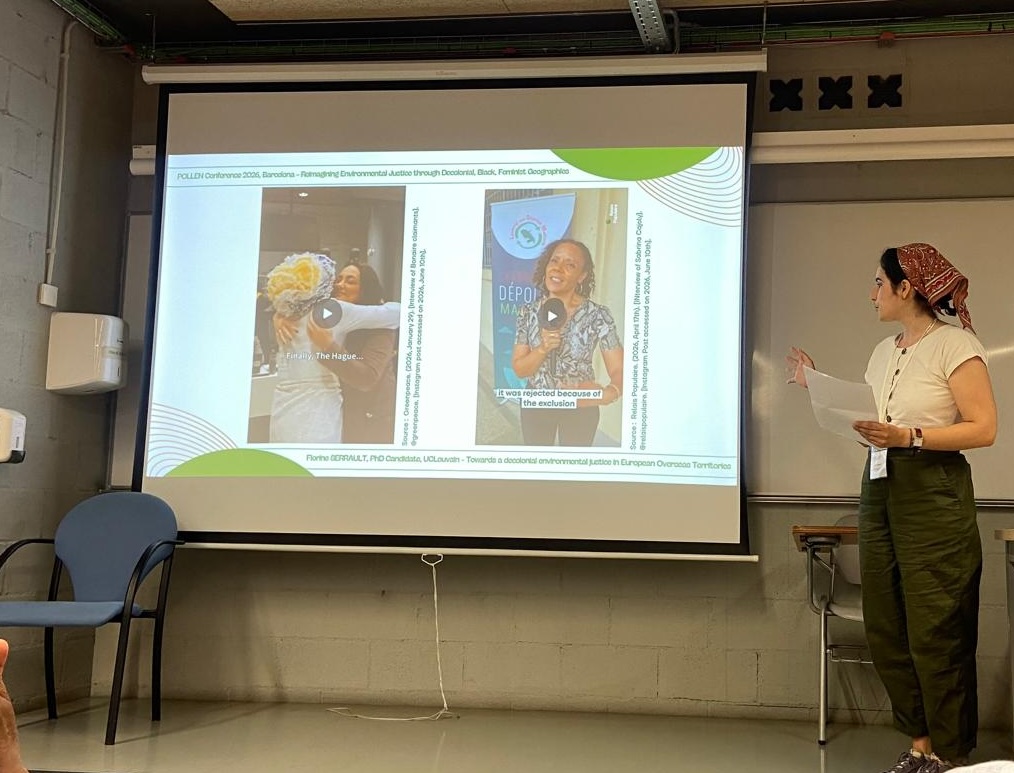
The 2026 edition of the international conference of the Political Ecology Network (POLLEN) took place from 29 June to 3 July at the Universitat Autònoma de Barcelona and the Universitat de Barcelona. From the CLAIM team, Florine Serrault, PhD candidate in political science, presented a part of her work in the session entitled ‘Reimagining environmental justice: feminist, Black and decolonial geographies’. On this occasion, she presented a preliminary comparative analysis of two case studies showcasing the use of climate litigation by activists and local communities in European overseas territories.
The presented paper explores how climate litigation is emerging as a powerful strategy for decolonial climate action in European overseas territories. These regions—often overlooked in global climate discussions—face unique vulnerabilities due to their colonial histories, geographic isolation, and economic dependence. Yet, they are also sites of resistance, where legal action is being used to challenge neocolonial domination and demand postcolonial equality and social justice. The presentation focused on the strategic use of climate litigation as an additional tool in the historical repertoire of action and resistance within overseas socio-environmental struggles.
The topic is structured around two case studies: the lawsuit brought by citizens of the Dutch island of Bonaire against the Dutch government for climate inaction, and the lawsuit brought by the Antillean collective Kimbé Rèd against the French State for excluding them from foundational European texts that would guarantee their environmental rights.
These cases highlight how climate change disproportionately affects communities of color, and how legal action can force former colonial powers to confront their ongoing responsibilities.
As the law is commonly acknowledged as a tool of coercive neocolonial domination, its use as a political strategy to overcome systemic discrimination embedded in environmental racism is worth looking into.
The examples of Bonaire citizens and Kimbé Red collective demonstrate that climate litigation in overseas territories is not just about winning in court—it is about reclaiming agency and rewriting the narrative of who gets to decide the future of these regions.
Ultimately, these cases show that climate justice in overseas territories is inseparable from a ‘determined demand for postcolonial equality and social justice, which resounds even stronger in the wake of the tempest’ (Ferdinand, 2018).
Leave a Reply