30 Apr 2026
A paper accepted at IWQoS 2026
The paper “Scylla: Scheduling Multiple Latency-Sensitive Applications in the Edge-Cloud Continuum” has been accepted at IWQoS 2026 as a regular paper in the Edge-Cloud Resource Allocation track.
We extend the scheduling methodology of LASSY to handle multi-application concurrency through the development of the Scylla global scheduling model. Recognizing that edge nodes are rarely dedicated to a single task, Scylla generalizes the single-application formulation to jointly schedule multiple co-located applications competing for shared resources across the edge-cloud continuum, mitigating the “Noisy Neighbor” effect through a holistic deployment plan that ensures all applications meet their respective SLOs without mutual performance interference. As the joint optimization of multiple applications causes the problem scale and computation time to grow rapidly, we further introduce the Layered Permutation Search (LPS) heuristic, which decomposes the global problem into a sequence of single-application problems and explores application orderings at controllable depth, achieving near-optimal placement plans within practical time limits even for large numbers of applications.
Yinan will present the paper during the conference during June 29 - July 2 2026 in Istanbul, Turkey.
13 Apr 2026
Maxime presented at MSR 2026
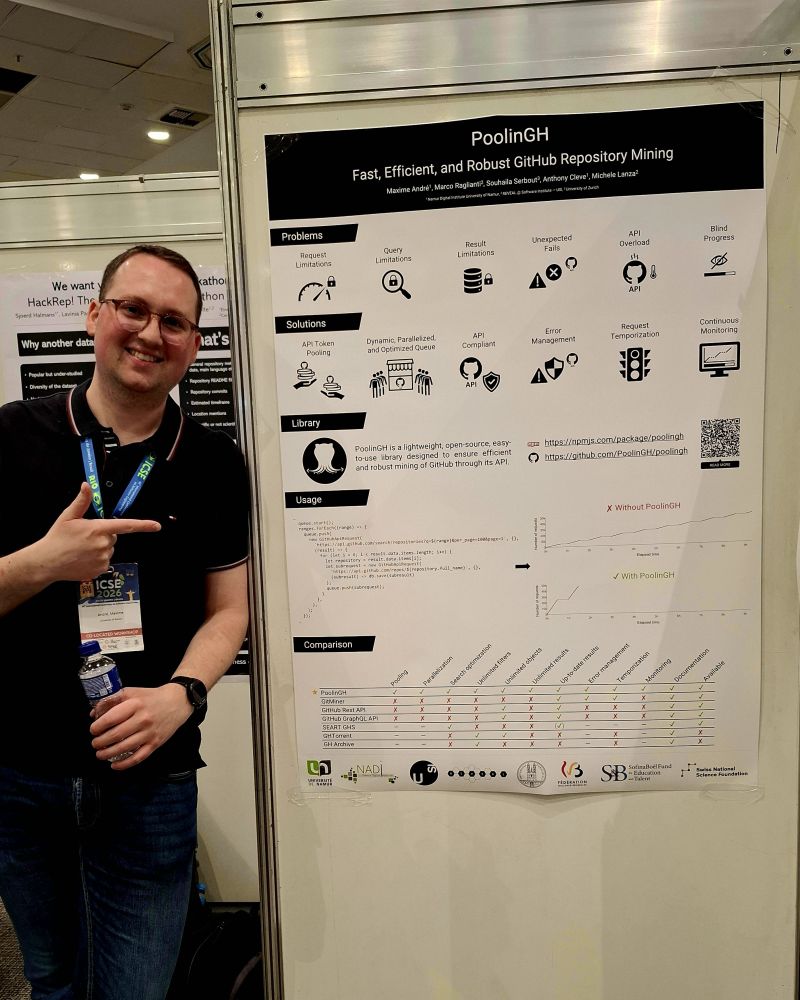
On April 13th, 2026, Maxime presented his works at MSR 2026.
The paper PoolinGH: Fast, Efficient, and Robust GitHub Repository Mining, approaches PoolinGH, a lightweight, open-source, easy-to-use library, aimed at supporting researchers.
05 Jan 2026
A paper accepted at MSR 2026
The paper “PoolinGH: Fast, Efficient, and Robust GitHub Repository Mining” has been accepted to
MSR 2026 in the Data and Tool Showcase track.
In this paper, we present PoolinGH, a lightweight, open-source, easy-to-use library, aimed at supporting researchers. It is designed to accelerate and ensure efficient and robust mining on the GitHub REST API while taking full advantage of its capabilities. It enables automatic pooling of multiple access tokens and parallelizes queries. It optimizes queues and regulates network and API usage for respecting GitHub’s limits and best practices. Error management and recovery or pruning in case of deadlocks are ensured. Search coverage maximization and progress monitoring are among the most useful features to avoid reinventing the wheel. We also provide solution templates that meet common needs for specific extensions of such library.
Maxime will present this paper with his co-authors mid-April 2026 in Rio de Janeiro (Brazil).
The paper was co-authored with researchers from the University of Zurich (Switzerland) and from the REVEAL research group of the Università della Svizzera italiana (USI) in Lugano (Switzerland). This collaboration is supported by the SofinaBoël Fund for Education and Talent.
03 Nov 2025
CNAM Researcher Patient Ntumba Wa Ntumba's 3-month visit to RAINDROP (UCLouvain)
We are pleased to announce that Dr. Patient Ntumba Wa Ntumba, a researcher from CNAM, France, is visiting our RAINDROP research group at UCLouvain for a period of three months, from November 2025 to January 2026. During his stay, Patient will collaborate closely with our team at UCLouvain on AI workload scheduling and adaptation on the edge.